The DfT transparency report, done properly.
Highways Transparency Reporter prepares, checks and publishes the DfT’s highways maintenance transparency report - prefilled from the published statistics, checked against DfT’s own consistency rules, and exported in the Department’s own template with the evidence behind every figure kept.
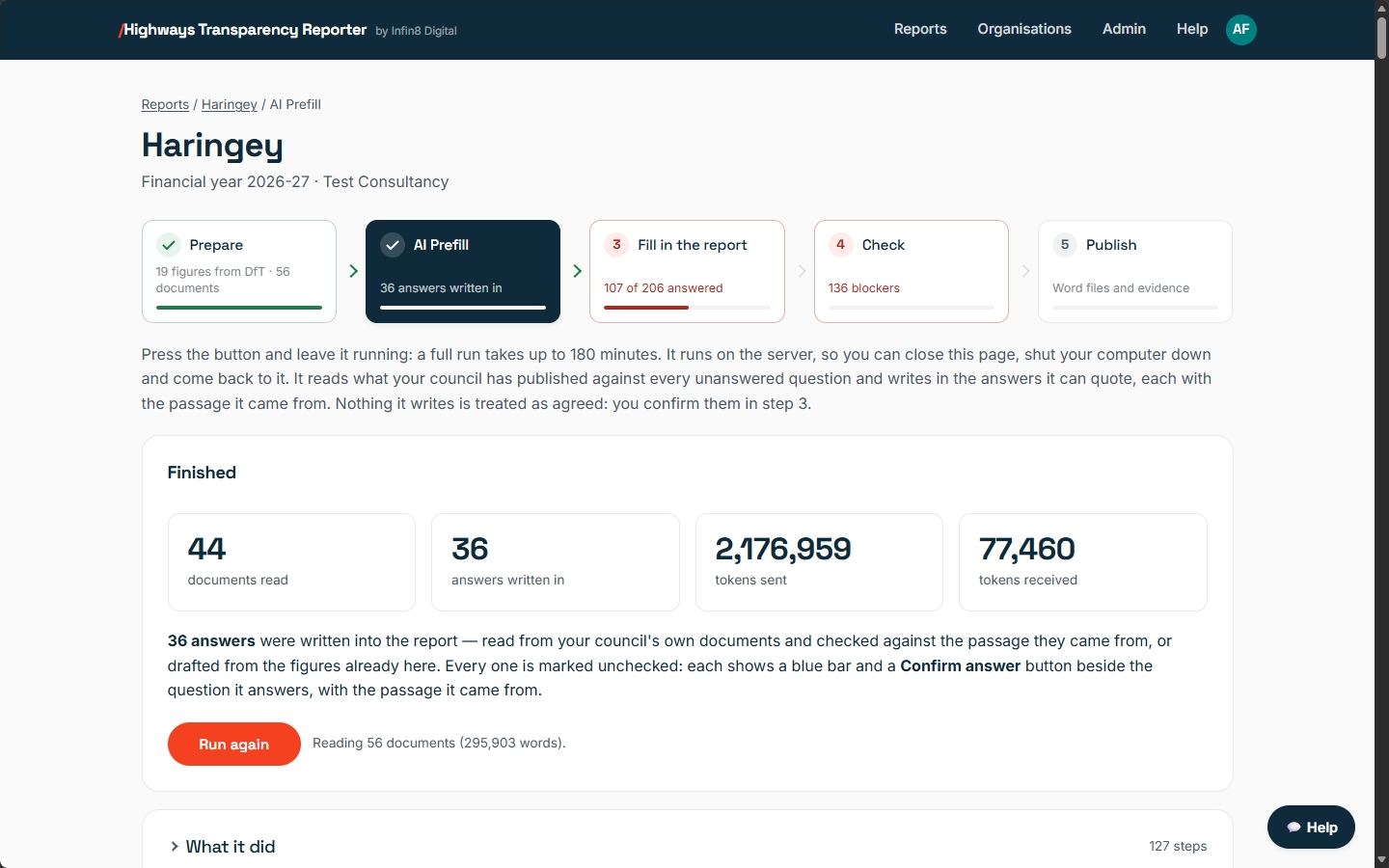
31 figures read straight from the published DfT tables. Each records its dataset code, the Department’s publication date and the exact cell, shown beside the field and optionally as an appendix in the export.
One button. It searches the authority’s own website, site map, search and committee system, reads what it finds alongside anything you have attached, and proposes answers — each carrying a verbatim quote checked against the document it cites.
PDF, Word, OpenDocument, spreadsheets, CSV, HTML and plain text converted to text in-process — no external conversion service, no OCR licence, and no upload leaving the server. Tables arrive as tables. Where reading a scanned page is switched on, those page images are transcribed by the drafting assistant’s provider, which is named on the security statement.
27 of DfT’s own cross-checks, recomputed every time the readiness page opens and separated into what blocks publication and what is merely worth a look.
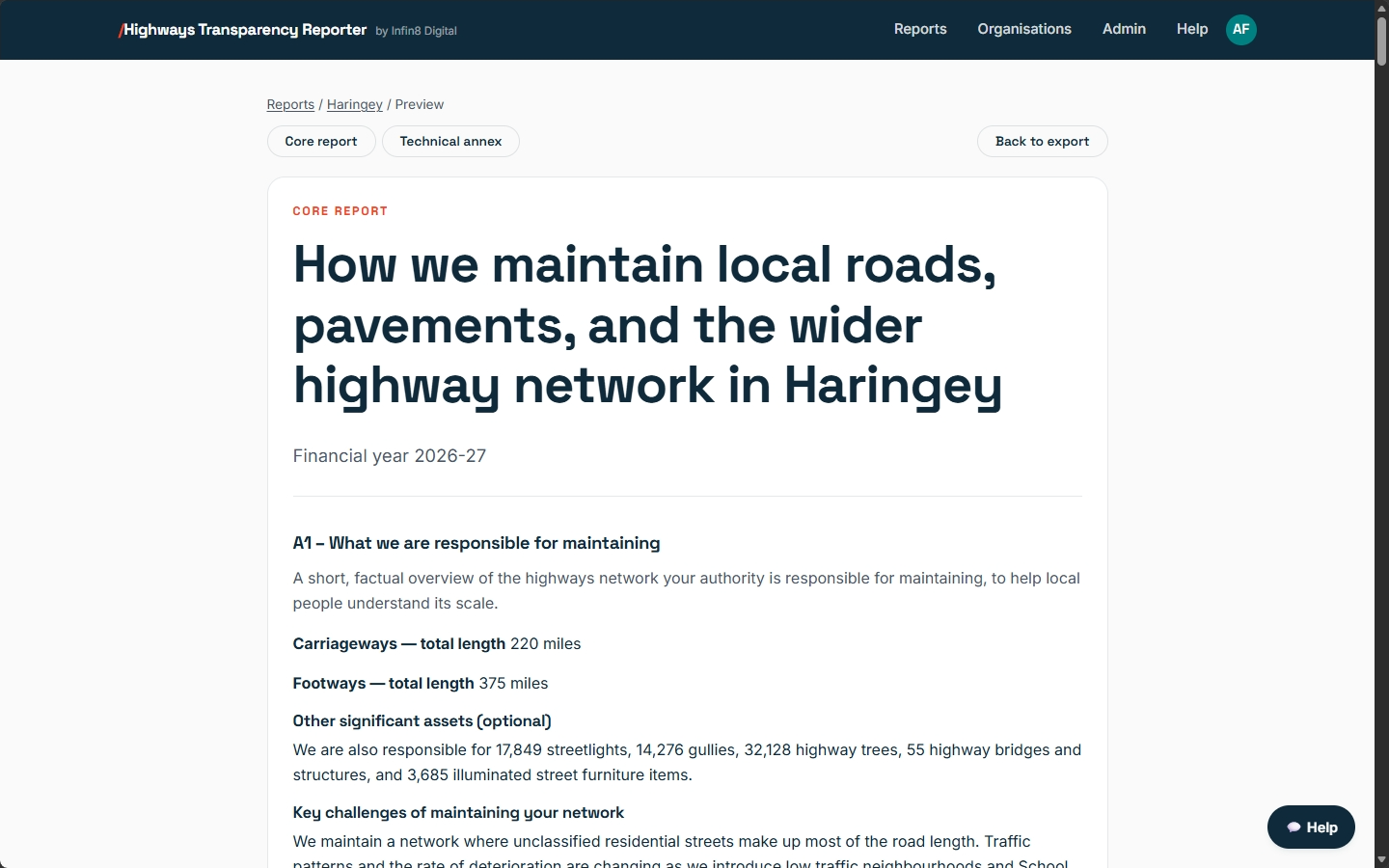
Word documents reproducing the Department’s own heading levels, column widths and condition-table shading. Tested against the template file itself, so a DfT revision fails our build rather than your document.
Every answer with where it came from, the source documents, the published tables with their checksums, and what the assistant proposed and a person rejected. The file to send when DfT samples.
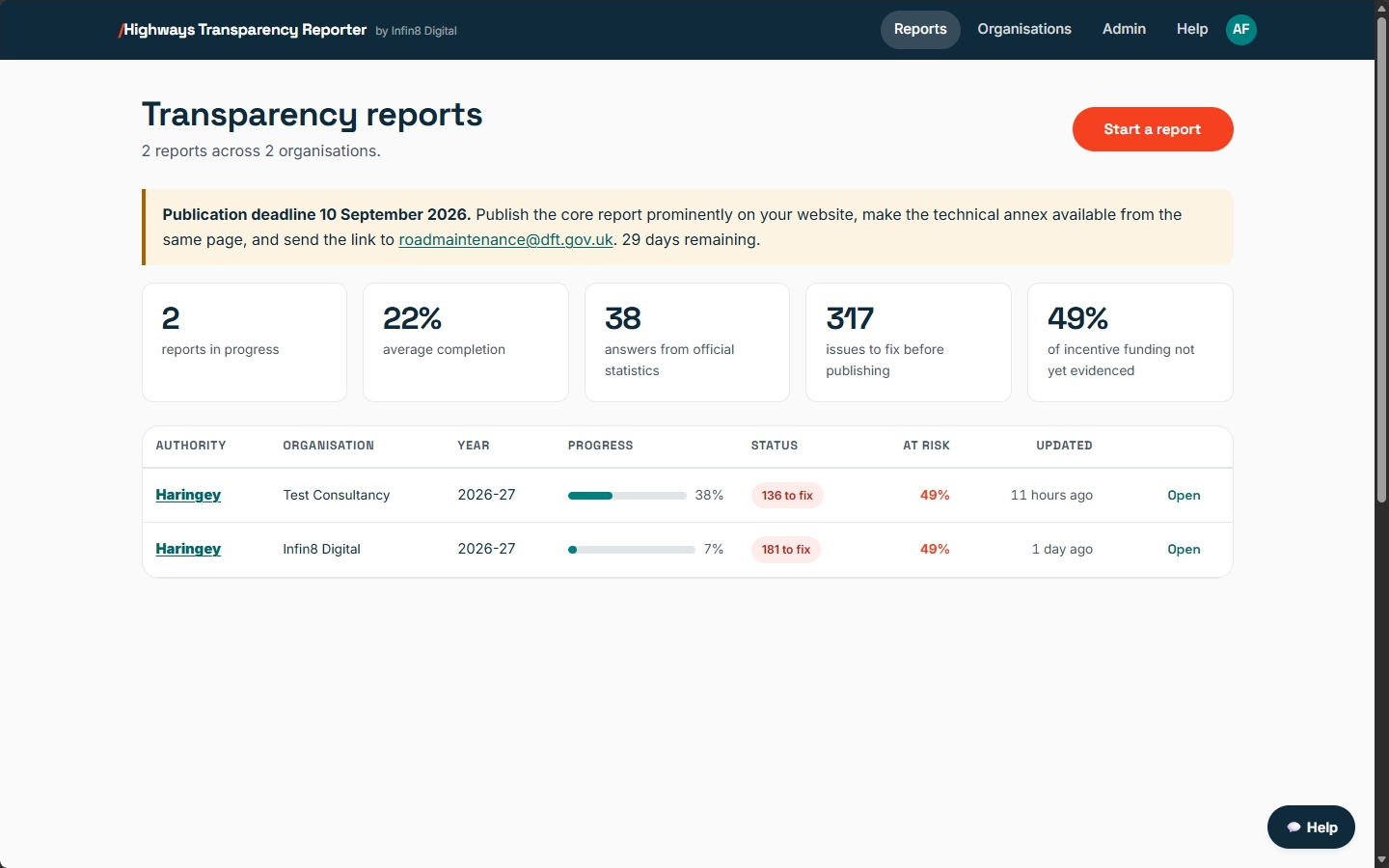
An authority’s highways team assembles roughly 320 answers across 63 tables, split between a core report and a technical annex whose figures must agree. Highways Transparency Reporter starts with the numeric sections already filled from the published statistics, reads the authority’s own asset management plan, pothole policy and inspection manual for the rest, and applies the Department’s consistency rules as the team works. What was a fortnight of assembly and reconciliation becomes a guided session, with an evidence trail behind every figure and a review queue ordered by risk rather than by report order.
A report can be complete and still say two different things about the same year. An authority that has drafted its return in Word can enter the answers and run the checking alone: 27 structural cross-checks, plus a reading pass that looks for contradictions, figures from the wrong year, unsupported claims and text nobody meant to publish. Every finding quotes the authority’s own words back, and one that cannot be found in the answer it names is discarded before anybody sees it. Nothing is published from it unless the authority chooses to, and the checking costs nothing.
A consultancy supporting a group of authorities, or a combined authority covering its constituent councils, runs each report in its own workspace with its own documents, its own colleagues and its own audit trail. The published statistics are shared; nothing else is, and whether a report exists for an authority is itself treated as information. Each report is licensed separately at the point it is published.
Let's explore how this solution fits your operations and delivers measurable value.
Access Online Now